A Letter from Gaza
The writer **Ghassan Kanafani** is one of the most important figures in Arabic literature. His work continues to influence writers around the world to this day, not only because he brought attention to the Palestinian cause, but also because of the innovative narrative techniques he employed. A writer, journalist, activist and politician, he became a leading member of the Popular Front for the Liberation of Palestine during the final years of his life, having joined the organisation in 1967.
He was born in 1936 in Acre, Palestine. He lived and studied at the French Frères School in Jaffa. In 1948, he fled as a refugee to Lebanon and later settled in Damascus. At the age of sixteen, he worked as a proofreader of literary texts, before joining the editorial team of *Al-Rai* and producing his own programmes for Syrian radio. He also taught literature and art in refugee schools.
He studied literature at the University of Damascus. In 1955, he moved to Kuwait, where he worked in schools and newspapers. It was there that he began writing literary works, and in 1958 he won his first literary prize for the short story *The Stolen Shirt*. He wrote more than sixty-five short stories, nine novels, three plays, a travel book and five studies. His works have been translated into more than eighteen languages.
He was assassinated in Lebanon in 1972, at just thirty-six years old, alongside his beloved seventeen-year-old niece, Mais, by an explosive device planted in his car by the Israeli intelligence service.
The graphic novel *A Letter from Gaza* by Lefteris Papathanasis, based on Ghassan Kanafani’s classic short story, is a deeply moving, timely and powerful work. Across fifty-six pages, it captures the tragedy, dignity and collective memory of an entire people.
The story is set in California in 1956. Mustafa, a young Palestinian man, waits at the airport for his close friend, who had promised to join him in emigrating to America so they could build a new life together. But his friend never arrives. A few days later, Mustafa receives a letter from him that changes everything. Through its pages, the narrator recounts his visit to a hospital in Gaza and his encounter with his injured niece, an experience that profoundly transformed his consciousness and led him to decide to remain in his homeland.
The graphic novel explores deeply existential and political questions without a trace of didacticism. It highlights the inner conflict between personal happiness — escaping to the West — and collective responsibility.
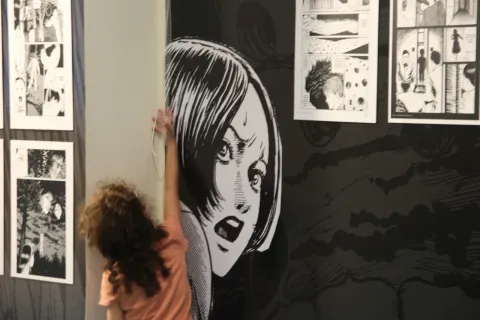
Lefteris Papathanasis’s illustrations function as an independent narrative voice. Through his distinctive black-and-white visual approach, he reimagines the short story and gives it a universal dimension. The wounded Gaza of every era becomes the true protagonist, speaking for itself as a symbol of resistance.
The central message revolves around resilience and identity. Palestine is presented not merely as a geographical place, but as a living demand for justice and dignity. Despite the sorrow and despair, the work leaves a powerful glimmer of hope and a spirit of resistance.
**Lefteris Papathanasis**, also known by his artistic pseudonym *boban*, is a distinctive and versatile creator on the Greek comics and illustration scene. His work stands out for its sociopolitical sensitivity and insightful perspective. Among his notable projects is the illustrated adaptation of Emmanouil Roidis’s iconic novel *Pope Joan*.